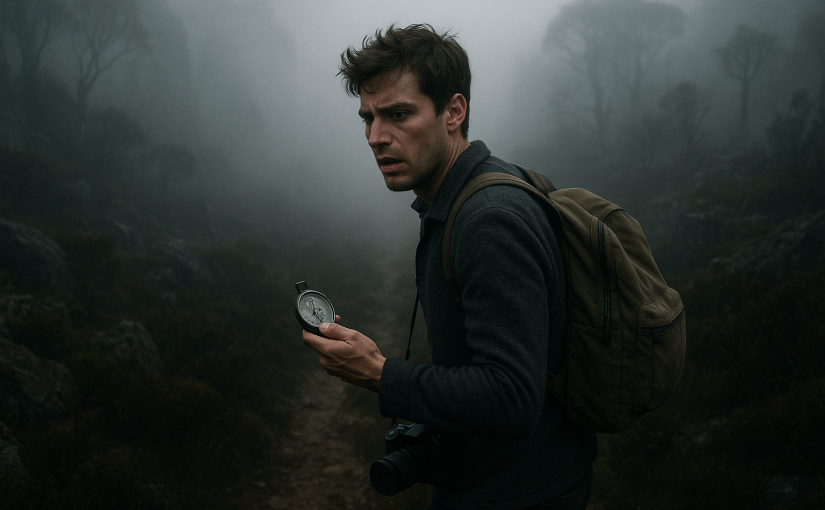
I’d been in the breathtaking Walls of Jerusalem National Park in Tasmania (Australia) for several days now, and the weather had been nothing short of glorious.
But one morning, I woke to a pale, diffused light filtering through the tent wall at around seven. A chill had crept into my neck. I unzipped the fly, poked my head out – and froze.
Fog. Thick as a wall. The world ended twenty, maybe thirty metres away. Sounds were muffled, as if someone had thrown a heavy blanket over the bush.
I pulled my head back in, crawled into my sleeping bag again. Picked up my book and tried to read while the mist hung, still and silent, between the trees.
Two hours later, around half past nine, I made myself breakfast. As I ate, an idea started forming – and soon it was stuck in my head like a catchy tune: Go out for an hour. Take photos in the fog. It’ll be magic.
So I packed my camera, slipped my compass and knife into my pocket, rugged up, and stepped into the white world.
The bush swallowed every sound. Tree trunks faded away like shadowy ribs into the grey. Out in the open, the fog hung like a curtain barely twenty metres away. The light was dull and drained of colour – as if someone had pulled the plug on the world’s paintbox.
After an hour, I reached Damascus Vale. The cliff loomed like a dark, brooding shadow in the fog. I decided to turn back, to return to the hut and my safe little tent.
Out of curiosity, I pulled out my compass. The reading was absurd – almost laughably wrong. I gave a nervous chuckle, put it away, and trusted my instincts instead, setting off in what felt like the right direction.
An hour later, nothing felt right anymore. The bush had changed, as if it had shifted me into another world. Then I saw it – a lake. A dark, still mirror beneath the fog. My heart raced. There wasn’t supposed to be a big lake anywhere near here.
I ran along its edge, scrambled uphill, stumbled along a bank. Time stretched. The forest grew stranger. A heavy feeling sank in my gut: I was lost.
I blew my whistle – three sharp blasts. The shrill sound cut the silence… then died, unanswered, in the mist. No voices, no cracking branches. Just the damp, smothering stillness.
Panic tried to rise, but I forced it down. Keep moving. Somewhere, there had to be a clue. Then I found a river, flowing lazily west to east, in a valley running the same way. I checked my map – nothing matched what I was looking at.
So I went back to basics: I knew my camp was north. I took out the compass – and it lied to me again. Metal in the rock, I thought, feeling the hairs on my neck prickle.
I tried a trick: stand in five different spots, take the direction that came up most often as north – and go.
Then came the wall. A slope so steep I had to use my hands. Sweat stung my eyes. At the top it got worse – dense bush, huge boulders, impossible terrain. I climbed, slipped, barked my shins. Eventually, I sat on a cold rock, breathing hard. For the first time, I had to admit it: I was in real trouble.
Climbing hadn’t helped, so I turned back and dropped into the valley again. And then – a miracle: the fog began to tear apart. Light broke through, first timid, then stronger. My heart leapt.
The joy was short-lived. The mountains around me were strangers. Not one familiar peak.
So I tried a new tactic – ruling out directions. Always avoid the most unlikely route, step by step. The valley took me uphill. I waded through a creek a few times, the icy water biting at my ankles. But hope grew – maybe I’d make it back to the hut before dark.
Half an hour later, Mount Moriah’s summit appeared through the last shreds of mist. I froze – and grinned. I had my bearings back.
Another hour, and I was standing by my tent. I’d been out for five hours – five hours in a world without a horizon.
That afternoon, I tried to shake off the shock. The workers restoring the historic hut here listened to my story, then gave a weary laugh. They told me plenty of people got lost in these parts. That helped restore a bit of my confidence – just a bit. I swore I’d never head out again in thick fog.
The rest of the day passed in the tent – reading, thinking, breathing. Around six, more hikers turned up. They had a laugh about the stone wall I’d built around my tent, and we ended up chatting for a while.
When darkness fell, I crawled into my sleeping bag. Warm, safe, and stretched out on my mat, I listened to the light wind outside – and felt grateful to be home again.
Photo taken in perfect weather, with the famous “Wall” in the Walls of Jerusalem National Park.
